
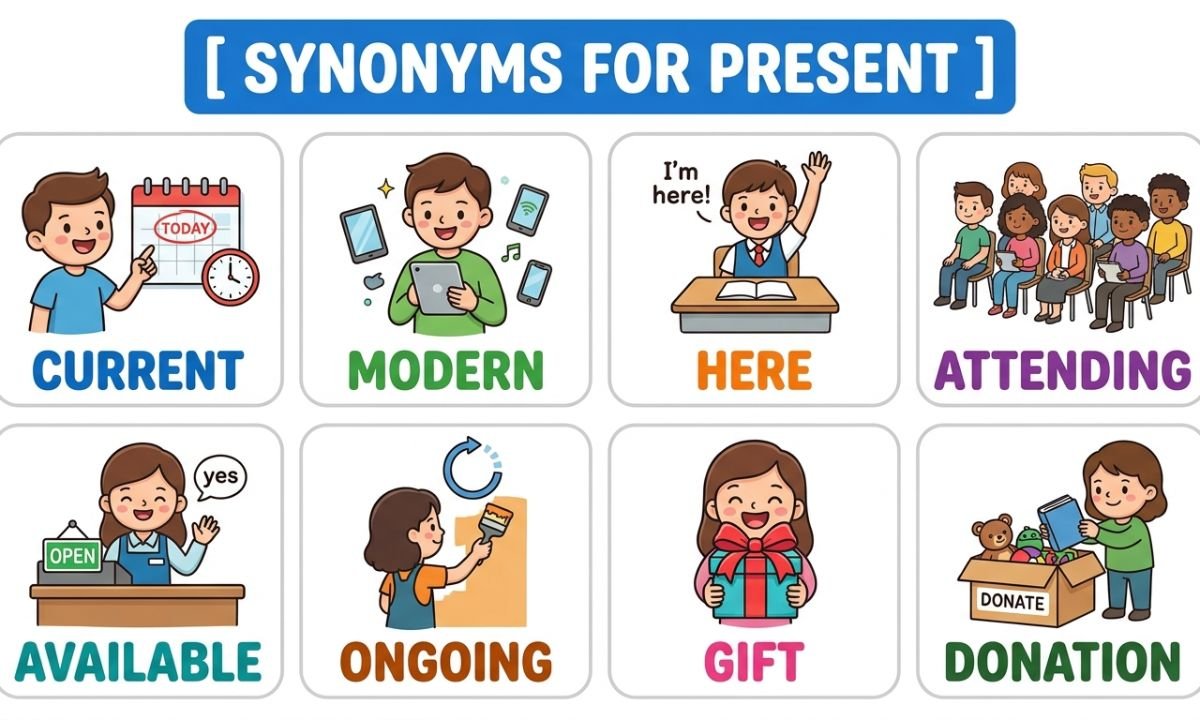
The word “present” does a lot of jobs. It can mean now, here, a gift, or the act of showing something. That is why one swap rarely works everywhere. This guide gives you another word for present in every major sense. Each entry explains the nuance and shows the word in action. You will also learn which swaps to avoid. Pick the right word and your writing gets sharper at once.
What Does “Present” Mean?
“Present” covers five main ideas. It can mean the current time, being physically in attendance, a gift, the act of giving, and the act of showing or introducing something. Each idea has its own set of present synonyms. A word that fits one sense often fails in another. That is the main reason a plain list of words similar to present can mislead you.
Is “Present” a Noun, Verb, or Adjective?
It is all three. As a noun, it means a gift or the current moment. As an adjective, it means existing now or being in attendance. As a verb, it means to give, show, or introduce.
Pronunciation and Word Forms
Stress changes with the part of speech. The noun and adjective sound like PREZ-uhnt. The verb sounds like prih-ZENT. Common collocations include “at present,” “present tense,” “present a case,” and “present an award.” Say them aloud and the difference is easy to hear.
Best Synonyms for Present at a Glance
| Meaning | Best Alternatives | Register |
| Current time | current, existing, ongoing, contemporary | Neutral to formal |
| In attendance | attending, available, on hand, here | Neutral to casual |
| A gift | gift, donation, offering, contribution | Neutral |
| Giving | give, offer, provide, bestow, confer, award | Neutral to ceremonial |
| Showing | display, show, exhibit, demonstrate, unveil | Business to creative |
| Introducing or submitting | introduce, submit, propose, deliver | Business to academic |
How to Choose the Right Synonym
Start with the sense, then check the register. Casual writing likes “give” and “show.” Business writing prefers “deliver,” “outline,” and “submit.” Academic writing leans on “demonstrate” and “propose.” Legal and ceremonial writing favor “confer,” “grant,” and “bestow.” Creative writing can use “unveil” and “reveal.”
When Not to Replace “Present”
Some swaps break the sentence. “Current” cannot replace present in “present an award.” “Gift” cannot replace present in “all students are present.” “Display” cannot replace present in “present a case to the board.” When the sense is unclear, keep the original word. A clear “present” beats a wrong synonym every time.
40 Synonyms for Present With Meanings
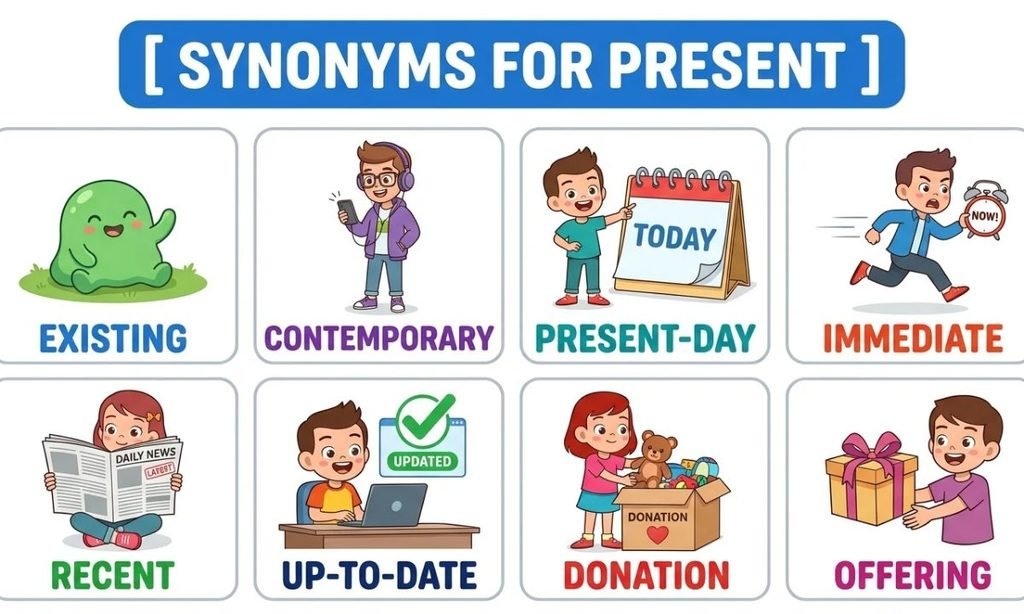
These present synonym examples are grouped by sense. Each one lists a short meaning, a note on nuance, and two sentences you can borrow.
Current
Meaning: Happening now
Current describes what is true at this moment, and it feels more neutral than “present.” Picture a manager asking about the current status of a project. It signals that your information is fresh and keeps the reader focused on today.
Usage Examples:
- Our current budget covers three hires.
- Please send the current version of the contract.
Existing
Meaning: Already in place
Existing points to what is already there, often in contrast to something new. Think of a team deciding whether to build a new tool or improve the existing one. It frames a choice clearly and sets a baseline for comparison.
Usage Examples:
- We will improve the existing process before adding steps.
- Existing customers receive the update first.
Ongoing
Meaning: Still continuing
Ongoing stresses that something has started and has not finished. Imagine reporting on a negotiation that is still open. It tells the reader to expect change and prevents them from treating the matter as settled.
Usage Examples:
- The audit is ongoing, and results arrive next month.
- We have an ongoing partnership with the school.
Contemporary
Meaning: Of today
Contemporary places something in the present era, not just the present moment. A museum guide might describe contemporary art to separate it from older work. It adds cultural context and a sense of period.
Usage Examples:
- The course covers contemporary writing on climate policy.
- Her style is contemporary but never trendy.
Present-Day
Meaning: Of this era
Present-day keeps the root word but narrows it to modern times. A historian comparing old borders with present-day maps uses it naturally. It makes a time contrast obvious without extra explanation.
Usage Examples:
- The ruins sit inside present-day Turkey.
- Present-day methods are faster than those used in 1990.
Immediate
Meaning: Right now
Immediate suggests the nearest point in time or concern. A project lead might say the immediate priority is fixing the outage. It sets urgency and tells the team what comes first.
Usage Examples:
- Our immediate goal is to restore access.
- The immediate cost is small, but the long-term cost is not.
Extant
Meaning: Still existing
Extant is formal and often used for records, species, or documents that survived. A researcher might note that only two extant copies remain. It adds precision and a scholarly tone.
Usage Examples:
- Only three extant manuscripts mention the event.
- The extant rules do not cover remote work.
Modern
Meaning: Up to date
Modern suggests current methods or styles, and it carries a positive feel. A buyer might want a modern kitchen, not just a working one. It signals relevance without sounding technical.
Usage Examples:
- We moved to a modern system for tracking orders.
- The report uses modern research methods.
Up-to-Date
Meaning: Fully current
Up-to-date focuses on accuracy and freshness of information. A nurse checking that a patient file is up-to-date wants no missing entries. It builds trust because the reader knows nothing has been left behind.
Usage Examples:
- Please keep your contact details up-to-date.
- The guide is up-to-date through this quarter.
Attending
Meaning: Taking part
Attending is the clean choice when someone is at an event or meeting. Picture a host confirming who is attending dinner. It keeps attendance lists crisp and professional.
Usage Examples:
- Six board members are attending the call.
- Everyone attending must register by Friday.
In Attendance
Meaning: Physically there
In attendance is formal and fits minutes, programs, and official notices. A secretary might record who was in attendance at a hearing. It gives the record a serious, official tone.
Usage Examples:
- The mayor was in attendance at the opening.
- Please list all staff in attendance.
Available
Meaning: Ready to help
Available means someone or something can be used or reached, not just that they are in the room. A client wondering if a consultant is available wants to know about open time. It sets clear expectations about access.
Usage Examples:
- Our team is available from nine to five.
- Two seats are still available.
On Hand
Meaning: Close by
On hand is casual and practical. A host might keep extra chairs on hand in case more guests arrive. It reassures people that help or supplies are nearby.
Usage Examples:
- A medic is on hand during the race.
- Keep spare cables on hand for the workshop.
A true treasure: Synonyms for Treasure: 30 Better Words and How to Use Them
Here
Meaning: In this place
Here is the simplest answer in casual speech or a roll call. A teacher calling names expects a quick “here.” It is short, human, and leaves no room for doubt.
Usage Examples:
- Is everyone here, or are we waiting for Dana?
- Our lead is here and ready to start.
Gift
Meaning: Something given
Gift is the most direct swap when present means a thing handed over. Think of a coworker wrapping a gift for a retirement party. It sounds warm and clear, and it works in nearly any setting.
Usage Examples:
- She brought a small gift for the host.
- The gift arrived a day before the party.
Donation
Meaning: Charitable gift
Donation implies giving to a cause, often to an organization. A neighbor might make a donation to the local food bank. It signals generosity with a purpose and often a public record.
Usage Examples:
- We received a generous donation from a local firm.
- Every donation supports the youth program.
Offering
Meaning: Gift made
Offering has a ceremonial or religious feel, and it can also describe what a business provides. A shop owner might lay out an offering of fresh bread for the new neighbors. It adds humility and care to the act.
Usage Examples:
- The group left a small offering at the shrine.
- Our newest offering helps teams plan faster.
Contribution
Meaning: Shared gift
Contribution suggests adding to a larger pool, like money or effort for a shared goal. A colleague might make a contribution toward a team gift. It credits the giver without making the moment grand.
Usage Examples:
- Her contribution funded the new lab.
- We welcome contributions of any size.
Give
Meaning: Hand over
Give is plain and warm, and it is less formal than “present.” A parent might give a child a book on the first day of school. It keeps the tone friendly and avoids stiffness.
Usage Examples:
- We will give each guest a printed map.
- Please give the team your feedback by noon.
Offer
Meaning: Make available
Offer puts the choice in the other person’s hands. A recruiter might offer a candidate a start date and let them decide. It respects the receiver and softens the request.
Usage Examples:
- We offer free training to every new hire.
- She offered her seat to the visitor.
Provide
Meaning: Supply what’s needed
Provide fits practical, business settings where something is needed. A hotel might provide breakfast with every booking. It communicates reliability and a sense of service.
Usage Examples:
- The agency will provide a full list of suppliers.
- We provide support around the clock.
Donate
Meaning: Give freely
Donate suggests giving without payment, often to charity and often in public. A company might donate laptops to a school. It signals goodwill and gives the act a clear purpose.
Usage Examples:
- The bakery will donate unsold bread each night.
- Several families donated books to the library.
Bestow
Meaning: Give formally
Bestow is formal and can sound lofty, even a bit condescending in the wrong setting. A university might bestow an honorary degree. It adds weight to the moment, so use it sparingly.
Usage Examples:
- The committee will bestow the honor next spring.
- The town bestowed a medal on the rescuer.
Lost in wonder: Synonyms for Stop: 35 Better Words for Every Situation
Confer
Meaning: Grant formally
Confer fits honors, degrees, and titles, and it implies a gracious giving. Picture a dean who confers degrees at graduation. It adds dignity and shows the giver holds proper authority.
Usage Examples:
- The school will confer degrees on Saturday.
- The board conferred the title of director emeritus.
Award
Meaning: Give prize
Award ties the giving to merit or a decision. A judge might award a prize to the best entry. It communicates that the recipient earned the outcome.
Usage Examples:
- The panel will award three grants this year.
- They awarded her a certificate for service.
Grant
Meaning: Formally allow
Grant often covers permission, rights, or funds. A landlord might grant a tenant extra time to pay. It signals official approval and sets a clear boundary.
Usage Examples:
- The city will grant permits within ten days.
- The foundation granted funds for the new clinic.
Display
Meaning: Put on view
Display focuses on visual placement, like items in a gallery or data on a screen. A shop might display new arrivals near the front. It tells the reader that something is meant to be seen.
Usage Examples:
- The museum will display the map for six months.
- The dashboard displays sales by region.
Show
Meaning: Make visible
Show is the everyday option and works almost anywhere present means to reveal. A designer might show a client two early sketches. It keeps the message simple and avoids sounding staged.
Usage Examples:
- Let me show you how the report works.
- The chart shows a clear rise in sign-ups.
Exhibit
Meaning: Show publicly
Exhibit suggests a formal public showing, like art or evidence. An artist might exhibit a new series in a local gallery. It adds a sense of occasion and care.
Usage Examples:
- Twelve artists will exhibit work this fall.
- The lawyer will exhibit the records in court.
Demonstrate
Meaning: Prove by showing
Demonstrate goes beyond showing and implies proof or a live walkthrough. A trainer might demonstrate how to use a new tool. It builds credibility because the audience sees the result.
Usage Examples:
- The study demonstrates a link between sleep and focus.
- She will demonstrate the app during the meeting.
Introduce
Meaning: Bring forward
Introduce works for people, ideas, and new products. A host might introduce a speaker before a talk. It sets context and makes the audience feel guided.
Usage Examples:
- I’d like to introduce our new head of design.
- The paper introduces a simple model for pricing.
Stage
Meaning: Put on
Stage suits plays, events, and organized shows. A theater group might stage a classic play each spring. It signals planning and performance rather than a casual reveal.
Usage Examples:
- The club will stage a small concert in May.
- They staged the demo in front of two hundred guests.
Unveil
Meaning: Reveal publicly
Unveil carries drama, as if a cover is being lifted. A company might unveil a new product on stage. It builds anticipation and gives the moment weight.
Usage Examples:
- The mayor will unveil the design on Monday.
- We plan to unveil the new brand next week.
Submit
Meaning: Formally send
Submit fits reports, applications, and proposals handed in for review. A student might submit a thesis to a committee. It makes the process feel orderly and signals that a decision will follow.
Usage Examples:
- Please submit your report by Friday.
- The team submitted the plan for approval.
Propose
Meaning: Put forward
Propose frames an idea as a suggestion open to discussion. An analyst might propose a new schedule to the team. It invites feedback and shows respect for the decision-makers.
Usage Examples:
- I propose we move the launch to June.
- The authors propose a new way to measure results.
Deliver
Meaning: Hand over
Deliver fits talks, results, and finished work. A consultant might deliver findings to a client at the end of a project. It suggests the work is complete and ready to use.
Usage Examples:
- She will deliver the keynote at nine.
- The team delivered the final report on time.
Outline
Meaning: Summarize briefly
Outline gives the main points without every detail. A manager might outline the plan in a short email. It keeps the reader focused and makes the plan easy to follow.
Usage Examples:
- Let me outline the three steps ahead.
- The proposal outlines costs and timelines.
Hand Over
Meaning: Give up
Hand over describes passing something to another person, often a duty or an item. A departing manager might hand over the keys on their last day. It marks a clear transfer and removes confusion about ownership.
Usage Examples:
- He will hand over the files on Monday.
- We handed over the project to the new team.
Reveal
Meaning: Make known
Reveal suggests that something hidden is now out in the open. A speaker might reveal the results after a long build-up. It creates a sense of discovery and keeps the audience engaged.
Usage Examples:
- The survey reveals what customers want most.
- She will reveal the winner at the end.
Showcase
Meaning: Highlight proudly
Showcase shows something in its best light. A startup might showcase its work at a trade fair. It signals confidence and invites the audience to look closely.
Usage Examples:
- The event will showcase local designers.
- Our portfolio showcases five years of work.
Frequently Asked Questions
What is another word for “present”?
The best option depends on the meaning, but “current,” “gift,” “give,” “attending,” and “display” cover the most common senses.
What is a formal synonym for “present”?
“Bestow,” “confer,” “grant,” and “in attendance” suit formal or ceremonial writing.
What can I say instead of “present” in a presentation?
You can say “introduce,” “outline,” “demonstrate,” “showcase,” or “deliver,” depending on what you are doing.
Is “present” a noun, verb, or adjective?
It works as all three, and the verb is stressed on the second syllable while the noun and adjective are stressed on the first.
What is the opposite of “present”?
The common antonyms are “absent,” “past,” “future,” and “withhold,” depending on the sense.
Conclusion
The right word does more than fill a gap. It tells readers whether you mean now, here, a gift, or a showing, and it sets the tone before they finish the sentence. A clear synonym builds trust, gives your message structure, and makes you sound confident and considerate at the same time. Choose by meaning first, then by register, and keep “present” when no swap fits.
1 thought on “Synonyms for Present: 40 Better Words by Meaning and Context”