
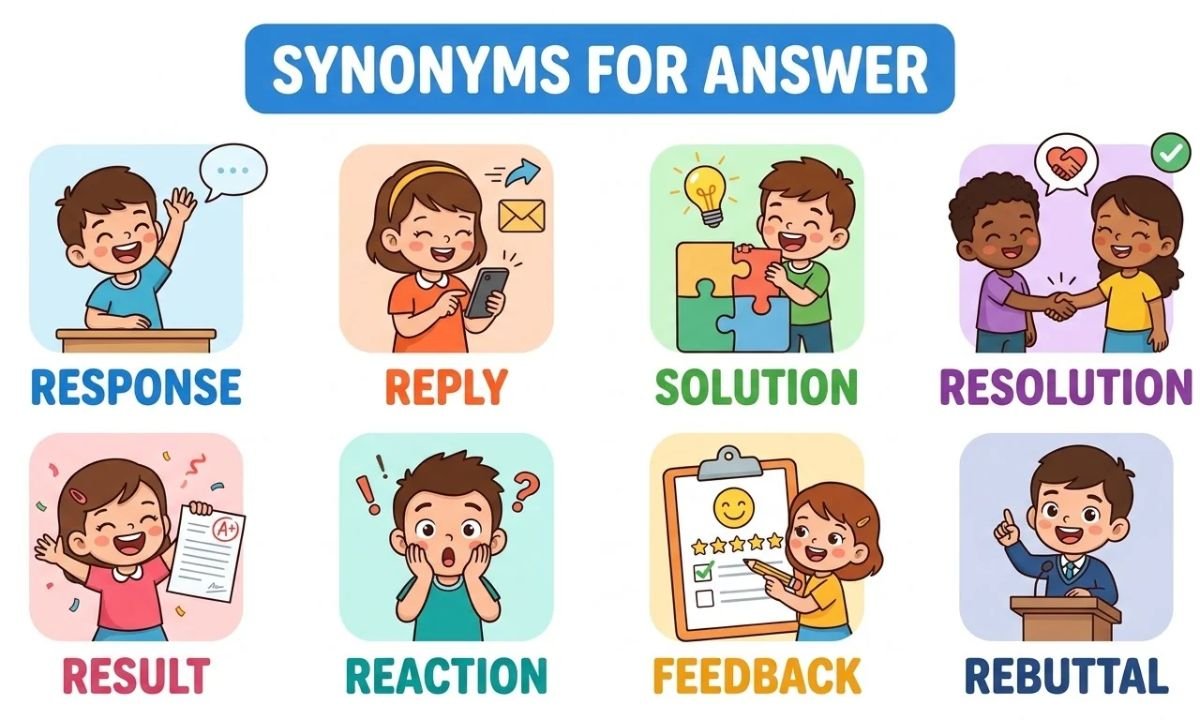
I use the word answer all day, and after a while it starts to sound flat. When I looked closely at the top results for synonyms for answer, I noticed most pages hand you a long list and walk away. Some lists run into the hundreds and include words like persiflage and guff, which almost nobody uses in real writing.
What stood out to me is how little help exists for business emails and everyday phrasal verbs. So I sorted another word for answer by tone, context, and part of speech. Below are 20 words to use instead of answer, each with an explanation and two example sentences.
Synonyms for Answer: Quick Facts
| Detail | Summary |
| Primary keyword | Synonyms for answer |
| Word origin | Old English andswaru, meaning “swear against” |
| Parts of speech | Noun and verb |
| Main contexts | Formal, workplace, problem-solving, informal |
| Alternatives covered | 20 |
| Gaps I filled | Workplace wording, phrasal verbs, a rebuttal vs. refutation comparison |
| Best for | Essays, emails, customer support, dialogue |
Answer vs. Reply vs. Response: Understanding the Core Difference
Answer works best when someone asked a question or made a demand, and you satisfy it. From my analysis of writing guides, the word comes from Old English and swaru, which means “swear against.” That history explains why answer carries a sense of meeting a challenge.
Reply fits a point-by-point response to a message. Response is broader and covers any reaction, including survey data. Those small differences are why blind swapping goes wrong.
As a noun, answer swaps with response, reply, solution, and reaction. As a verb, it swaps with respond, reply, address, resolve, and acknowledge. Keep that split in mind as you scan the list below.
When to Use Each Word Correctly
- Answer: closes a question or demand. “Her answer settled the argument.”
- Reply: responds to a specific message. “I sent a reply within the hour.”
- Response: covers a wider reaction. “The survey response rate was high.”
Formal Synonyms for Answer (Essays, Academic and Legal Writing)
If you need a synonym for answer in an essay, pick a word that names what the answer actually is. These four are the formal synonyms for answer I trust most in research and explanations.
Response
A response is a reaction to a question, request, or event, spoken or written. It fits essays, surveys, and official letters where reply feels too casual. It keeps the tone neutral and shows you take the other person seriously.
Examples:
- The committee’s response arrived within two days.
- Her response to the final survey question was short but clear.
Finding
A finding is an answer that a study or investigation produced. Use it in reports, research summaries, and academic essays. It signals evidence instead of opinion, which helps readers trust your claim.
Examples:
- The main finding was that shorter surveys got more completed replies.
- One unexpected finding changed how the team planned the next test.
Interpretation
An interpretation is a reading of what data or a text suggests, not a fixed fact. It fits literature essays and data analysis where several readings are possible. It shows you are reasoning, and it invites the reader to discuss your view.
Examples:
- My interpretation of the results is that customers wanted faster support, not lower prices.
- Each critic offers a different interpretation of the final scene.
Elucidation
Elucidation means a clear explanation that removes confusion. It is rare, so save it for academic papers and legal commentary. It signals care and expertise, though it can sound stiff in a casual email.
Examples:
- The professor’s elucidation of the theory made the whole chapter easier to follow.
- The report ends with a short elucidation of how the figures were calculated.
Best Words for Arguments and Debates (Rebuttal, Refutation, Rejoinder)
In debate writing, the word you pick shows how hard you are pushing back. I grouped these three by strength, from measured to firm.
Rebuttal
A rebuttal is a formal answer that argues against a claim, usually with evidence. It fits debates, legal briefs, and opinion pieces. It signals structured, respectful disagreement rather than a personal attack.
Examples:
- The lawyer prepared a rebuttal to each point in the complaint.
- Her rebuttal used two studies to challenge the original claim.
Refutation
A refutation claims to prove the other side wrong, not just disagree. Use it only when you can back it up with facts or logic. It signals confidence, but overusing it makes you sound arrogant.
Examples:
- The article is a full refutation of the rumor.
- His refutation left no room for doubt about the timeline.
Rejoinder
A rejoinder is a reply to an answer already given, the next move in an exchange. It fits formal debates, journal exchanges, and legal writing. It signals that you are continuing the conversation instead of closing it.
Examples:
- The author published a rejoinder to her critics a month later.
- His rejoinder was polite, short, and hard to argue with.
Professional Synonyms for Answer (Business Emails and Workplace)
In workplace writing, another word for answer should tell people what happens next. This is the gap I noticed most in competing pages, and it is where I think readers need the most help.
Verb swaps that work well in emails: address, resolve, clarify, acknowledge, and field. For example, “I’ll address your question today” sounds warmer than “I’ll answer your question.”
Follow-Up
A follow-up is a message sent after an earlier one, often with the missing details. It fits customer support, sales, and project emails. It tells the reader you kept your promise and did not forget them.
Examples:
- I’ll send a follow-up with the pricing details by Friday.
- Thanks for your follow-up, it cleared up the delivery date.
Confirmation
A confirmation is an answer that says yes, something is set or true. It fits bookings, approvals, and orders. It lowers stress because the reader knows the matter is settled.
Examples:
- Please send written confirmation of the new deadline.
- We received confirmation from the vendor this morning.
Guidance
Guidance is advice that points someone toward the right answer. It fits managers talking to their team and support agents talking to customers. It offers help without forcing a decision.
Examples:
- Our legal team gave us guidance on the contract wording.
- I would appreciate your guidance on which option to choose.
Resolution
A resolution is an answer that ends a problem. It fits complaints, technical support, and disputes. In my experience, it is the word customers most want to see, because it signals closure.
Examples:
- We reached a resolution with the client on Monday.
- Thank you for your patience while we worked toward a resolution.
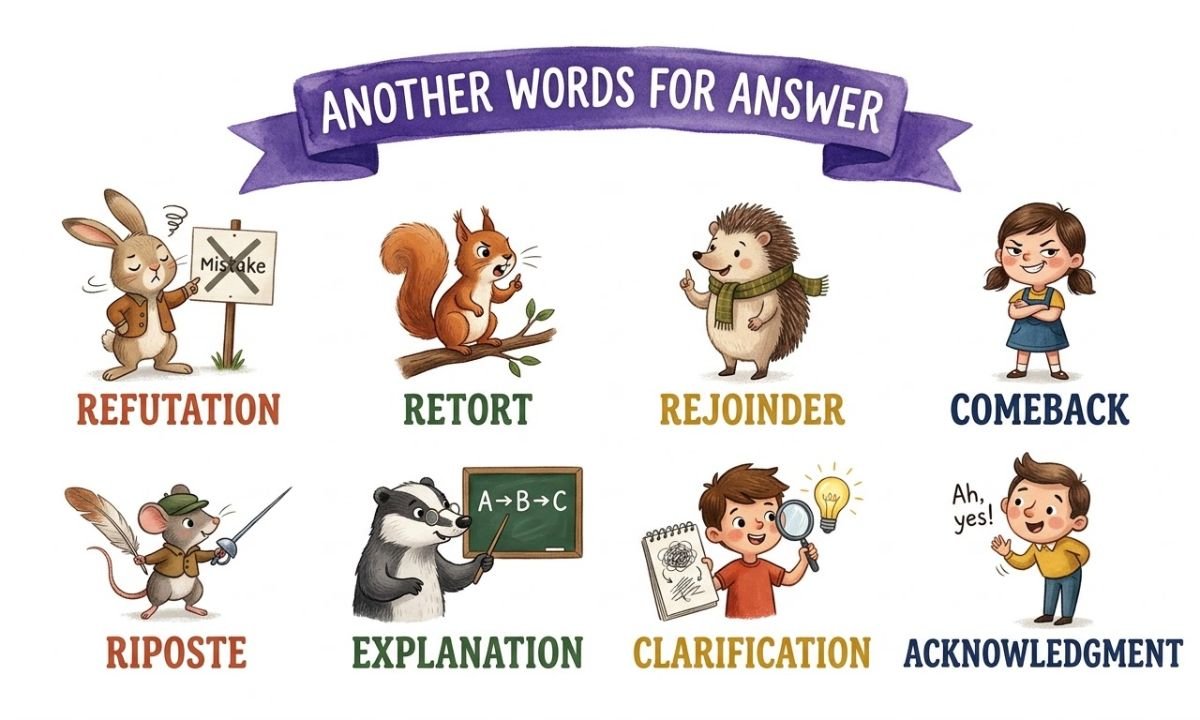
Problem-Solving Synonyms for Answer (Math, Logic and Strategy)
When the answer is something you work out, name the type of outcome. These four nouns cover most math, logic, and strategy writing.
Solution
A solution is the way to fix a problem or the correct result of a puzzle. It fits math, tech, and business writing. It signals progress and gives the reader a sense of relief.
Examples:
- The solution to the equation took three steps.
- We tested a new solution for the checkout bug.
Result
A result is what you get after a calculation, test, or process. It fits science, analytics, and lab reports. It is neutral and carries no judgment, which is exactly why researchers like it.
Examples:
- The result surprised everyone on the team.
- Compare the result with last quarter’s numbers.
Remedy
A remedy is a fix for something that is wrong or harmful. It fits health, legal, and process issues. It signals care and action, so it works well when someone is frustrated.
Examples:
- The simplest remedy was to update the software.
- The court offered a remedy for the broken contract.
Conclusion
A conclusion is where reasoning lands after you weigh the evidence. It fits essays, logic problems, and strategy memos. It signals that the answer was earned through steps, not guessed.
Examples:
- Her conclusion followed directly from the data.
- After two weeks of testing, we reached a clear conclusion.
Informal and Dialogue Synonyms for Answer (Creative Writing and Speech)
Casual speech and fiction need sharper, shorter words. If you want the whole back-and-forth, the word is repartee, but these three describe a single reply.
Retort
A retort is a quick, sharp reply, often with some anger behind it. It fits fiction and heated arguments. It signals heat, so I avoid it in a polite business email where clarification or acknowledgment reads better.
Examples:
- “That’s not what I said,” he snapped in retort.
- Her retort silenced the whole table.
Riposte
A riposte is a quick, witty reply, borrowed from fencing. It fits banter and dialogue where you want a character to sound clever. It signals intelligence and humor, not hostility.
Examples:
- She answered his joke with a perfect riposte.
- The host’s riposte got the biggest laugh of the night.
Comeback
A comeback is a clever reply to a joke or an insult. It fits casual talk, social media, and friendly teasing. It signals confidence and fun, so keep it out of formal writing.
Examples:
- I thought of the perfect comeback an hour too late.
- His comeback made even the referee smile.
Everyday Phrasal Verbs to Replace Answer (Get Back To, Clear Up, Field)
Almost no page I checked compared single words with phrasal verbs, and these sound the most natural in speech. Field is a third option when you want to say you will handle a tough question: “I’ll field that one.”
Get Back To
To get back to someone means to reply later, after you check something. It fits everyday work chat and quick messages. It tells the other person you have not ignored them, which calms them down.
Examples:
- I’ll get back to you after I check the schedule.
- Can you get back to me by noon?
Clear Up
To clear up something means to explain it so the confusion goes away. It fits support chats, classrooms, and friendly emails. It signals patience and makes the other person feel respected.
Examples:
- Let me clear up the confusion about the invoice.
- A quick call cleared up the whole misunderstanding.
Quick Nuance Guide: Rebuttal vs. Refutation vs. Retort vs. Rejoinder
Readers struggle to tell these four apart, and I found no top page with a comparison. Here is the quick version.
| Word | What it does | Tone | Best for |
| Rebuttal | Argues against a claim with evidence | Formal, measured | Debates, legal briefs |
| Refutation | Aims to prove a claim false | Firm, confident | Fact-checking, research |
| Rejoinder | Replies to an earlier answer | Formal, continuing | Journals, formal exchanges |
| Retort | Snaps back quickly | Sharp, heated | Fiction, arguments |
Common Thesaurus Mistakes to Avoid When Replacing “Answer”
Blind swapping is where most bad word choices start. These are the four mistakes I saw most often in the guides I reviewed.
- Swapping response and answer in survey data. A response is what a person submitted, while an answer is the content of it.
- Using retort in a polite email. It sounds angry, so acknowledgment or clarification fits better.
- Copying words from bloated lists. Terms like persiflage and guff add noise and often get flagged as unnatural.
- Ignoring part of speech. Resolution works as a noun but not as a verb, so check before you swap.
Frequently Asked Questions
What is the closest synonym for the word answer?
Reply and response are the closest, depending on whether you are answering a message or a wider situation.
What is another word for answer in formal writing?
Response, finding, interpretation, and elucidation all work well in formal writing.
What is a good synonym for answer in an essay?
Use finding or conclusion when your answer comes from evidence, and interpretation when it is a reading.
What is the difference between an answer, a reply, and a response?
An answer satisfies a question, a reply answers a specific message, and a response covers a broader reaction.
What are synonyms for answer as a verb?
Respond, reply, address, resolve, clarify, and acknowledge all replace the verb well.
Conclusion
What I found after sorting these words is that the best synonym for answer depends on who is asking and what you owe them: evidence in an essay, closure in a customer email, a sharp line in dialogue, or a plain “I’ll get back to you” in everyday chat. Start by naming the situation, then pick from the matching group instead of grabbing the longest list you can find. Check part of speech, match the tone, and say the sentence out loud before you commit. If it sounds like something a real person would say, you chose well.